
The griffin, known as γρύφων in ancient Greek and Griffin in English, is a legendary creature widely featured in the region stretching from the Near East to the Mediterranean. It is typically depicted as a mythical creature with the body of a lion and the head, beak, and wings of an eagle. Since the lion symbolizes strength on land and the eagle represents the sky, the griffin is regarded as a symbol of power and nobility.
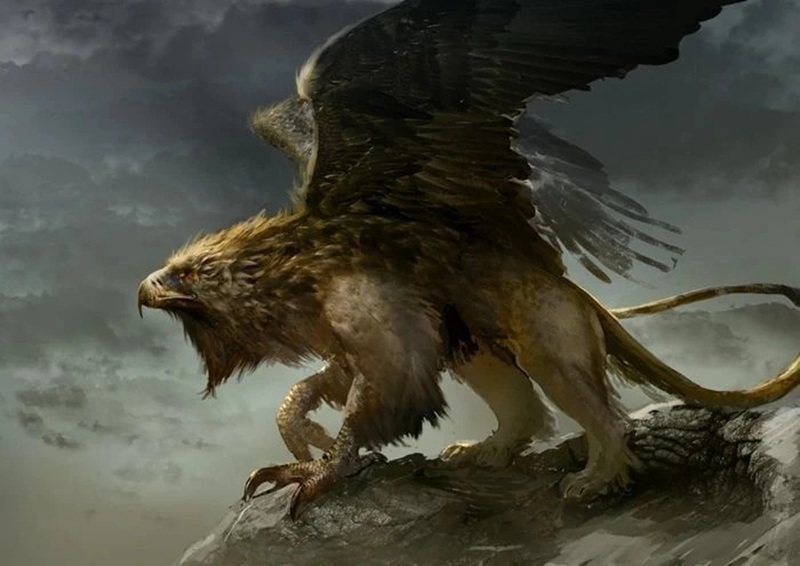
What is the origin of the Griffin?
The earliest depictions of the Griffin can be traced back to ancient Egyptian and Persian art dating to before 3000 BCE. In Greek mythology, the Griffin was a divine beast of Zeus, said to gather gold from the shores of the Cyclopes in the distant East. In the lost ancient Scythian poem –The Cyclops, griffins nest and lay eggs like eagles. They lived near the far-northern land of Hyperborea, where gold and gemstones were abundant. Griffins were tasked with guarding gold mines and treasures; when strangers approached, they would pounce and tear them to pieces.
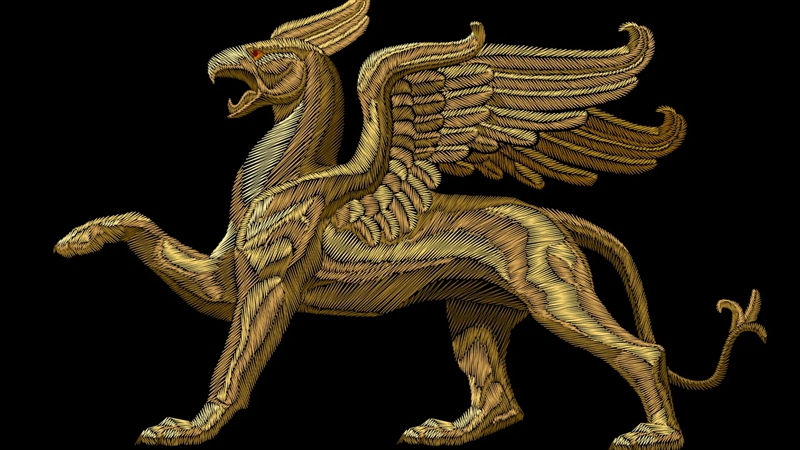
What are the characteristics and features of a griffin?
The griffin’s form combines the traits of the kings of land and air, embodying the ultimate fusion of strength and majesty:
Body Structure: The upper half features the head, wings, and talons of a male eagle, symbolizing dominion over the skies and keen insight. The lower half consists of the torso and hind legs of a male lion, with a tail resembling that of a lion, ending in a tuft of fluffy fur that helps balance the body during flight and running. This represents the lion’s status as the ruler of the land and its fearless courage.
Additional Features: Some depictions feature a serpentine tail or a mane, enhancing its air of mystery. In art, it is often portrayed as entirely golden, with eyes like flames, standing at the entrance to a treasury or temple.
What does the griffin symbolize?
1. Power and Divinity: The lion and the eagle symbolize dominion over the land and the sky, respectively. The griffin, as a hybrid of the two, embodies supreme sovereignty and divine will, and is commonly found on royal seals and temple decorations.
2. Duality of Good and Evil: Guardian—protecting treasures, temples, and justice, while warding off greed and desecration. Punisher—displaying ferocity toward intruders, acting as the ruthless enforcer of natural laws.
3. A Metaphor for the Cycle of Life and Death: The union of the eagle (sky, sun) and the lion (earth, strength) symbolizes the connection between heaven and earth within the cosmic order, as well as the eternal flow of life energy.
What are the applications of the Griffin in mythology and sculpture?
Sacred Guardian: The griffin is often depicted as the mount or servant of Apollo (the sun god) and Nemesis (the goddess of vengeance), guarding sacred domains. At sacred sites such as the Temple of Delphi, griffin figures are carved onto columns, symbolizing the inviolability of the oracle.
Defenders of Gold: According to Herodotus, griffins guarded gold mines in the far north (possibly Central Asia or Siberia), waging an eternal battle against the gold-stealing Arimaspians. This legend may allude to the struggle over ancient gold trade routes.
Symbol of Art and Architecture:
In ancient Greek pottery and sculpture, the griffin is often depicted alongside the sphinx and the chimera as a representative of mythical creatures. – At the Minoan civilization sites on Crete, griffin murals are regarded as symbols of royal authority and divinity.
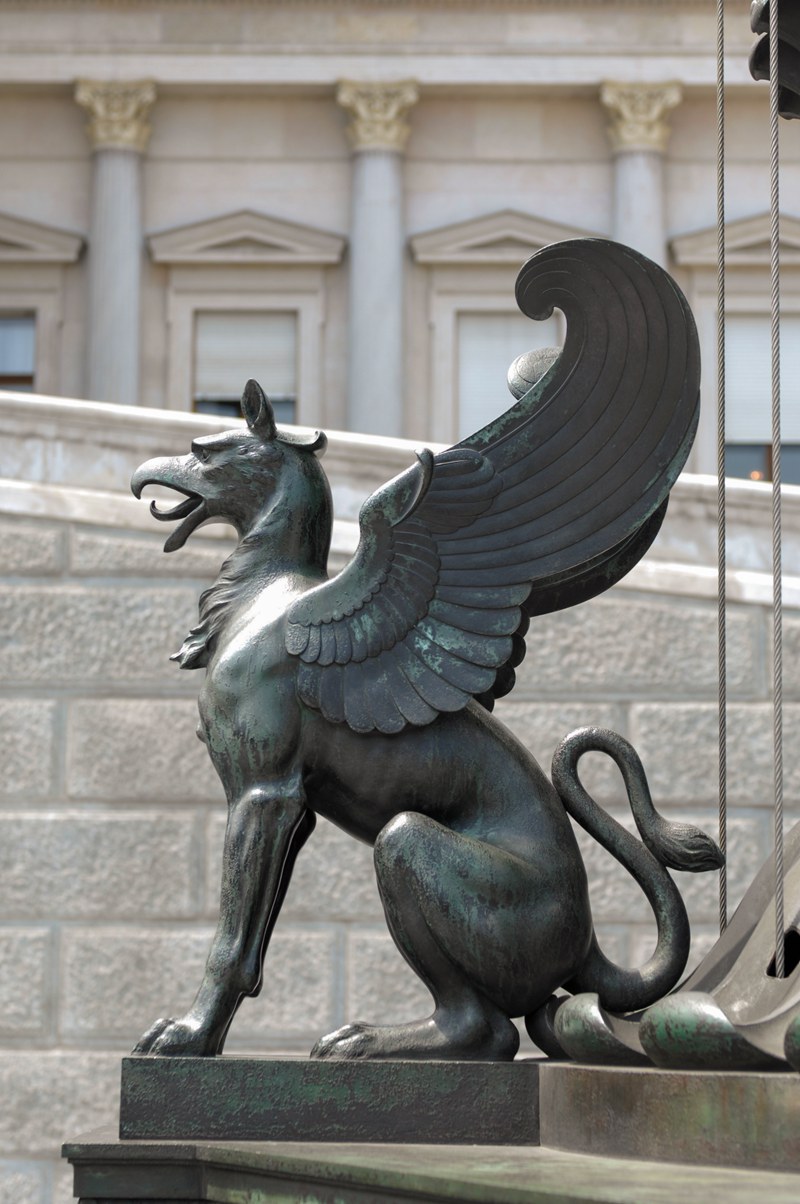
In the architecture of the ancient Elamites, the griffin emblem was widely used. In Persian mythology, the griffin is known as “Homa,” and its image was employed in court sculptures and emblems. In architectural motifs, the griffin is typically depicted as a mythical creature with four legs, a pair of wings, and either a leopard’s head or an eagle’s head.
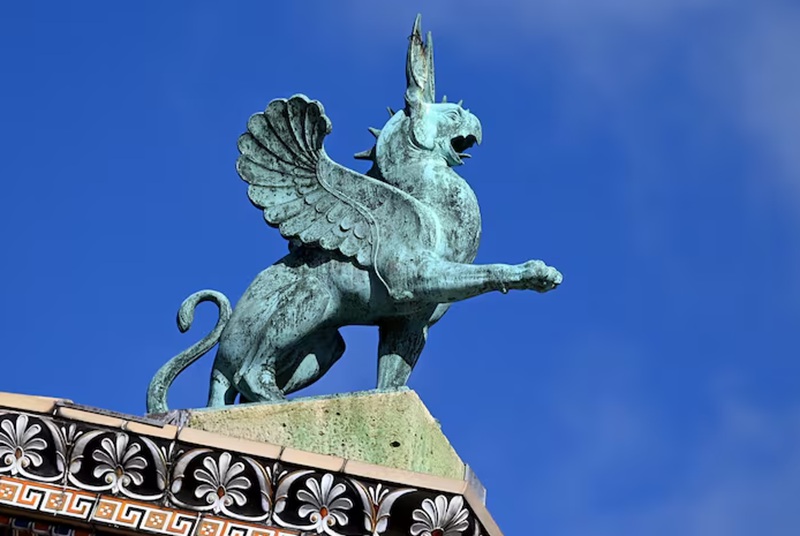
Due to its image as a guardian, the griffin serves as the emblem of the Philadelphia Museum of Art, where bronze castings of the creature can be seen at each corner of the museum’s roof. Additionally, griffin motifs are frequently found in royal and noble coats of arms.
The griffin is also a common figure in various games and films, such as “Harry Potter” and “World of Warcraft”.
The griffin is not merely a mythical creature but a cultural symbol spanning thousands of years. Combining strength, beauty, and symbolic meaning, it is ideally suited as a guardian sculpture at the entrance to an estate.
For marble or bronze sculptures, the griffin motif offers powerful visual impact and cultural significance, making it an excellent choice for high-end custom projects.
If you are looking for a sculpture that is both symbolic and beautiful, feel free to contact us for information.


