
An athlete statue for a stadium, training center, golf club, or aquatic venue should do more than resemble a player. It needs to tell a story, fit the site, withstand public use, and arrive in time for a real installation—not merely leave the foundry before the unveiling. To commission one, define the person and moment you want to honor, document the site, agree on likeness and branding permissions, approve a full-scale model, and plan the foundation and delivery alongside the bronze work.
At Trevi, we begin with the decisions that determine whether a sculpture will work in its intended location: pose, viewing distance, overall dimensions, finish, base, and the route it will take into the venue. Our sport statue collection offers starting points for different sports, but a successful commission is shaped around your own brief.
1. Decide what the statue should commemorate
Is this a portrait of a specific athlete, a tribute to a team, or a non-portrait figure celebrating the sport? That choice affects the reference materials, approval group, inscription, and design schedule.
For a named athlete, collect authorized photographs from several angles and periods, along with uniform references and a list of defining details. A single action photograph can show the pose, but it may not give a sculptor enough information to model the face, equipment, or back of the figure accurately. Confirm who may approve the likeness and whether the venue has permission to reproduce the athlete’s image, team marks, sponsor elements, and any source photography. Requirements vary by jurisdiction and agreement; have the relevant rights holders or legal adviser review the proposed use rather than assuming that a publicly available image is free to reproduce.
For an anonymous sporting figure, decide what the action communicates. A sprint suggests drive; a follow-through can suggest mastery; a poised figure may create a quieter memorial. Ask your committee to agree on one central idea before debating small details.
2. Pick a pose that reads from the venue’s main approach
Sports sculptures are usually encountered in motion: visitors walk toward them, pass them, and photograph them. A pose that reads well in a close-up drawing may disappear against a busy stadium facade. Walk the site and take photographs from the main arrival route, the intended photo spot, and any upper-level views. Then test the proposed silhouette against those backgrounds.
Consider three examples from our product pages as design references, not documentation of installations at your venue:
- A bronze American football player uses a running, ball-carrying pose. For a stadium entrance, check that the extended leg, ball, and uniform remain legible from the approach—not only from the front.
- A life-size bronze golfer freezes the follow-through. At a golf club, allow enough open space that the club’s outline remains visible and cannot intrude into a walking route.
- A bronze diver makes the body’s inverted line the focus. An aquatic center could use that vertical gesture as a design reference, subject to a site-specific structural and safety review.
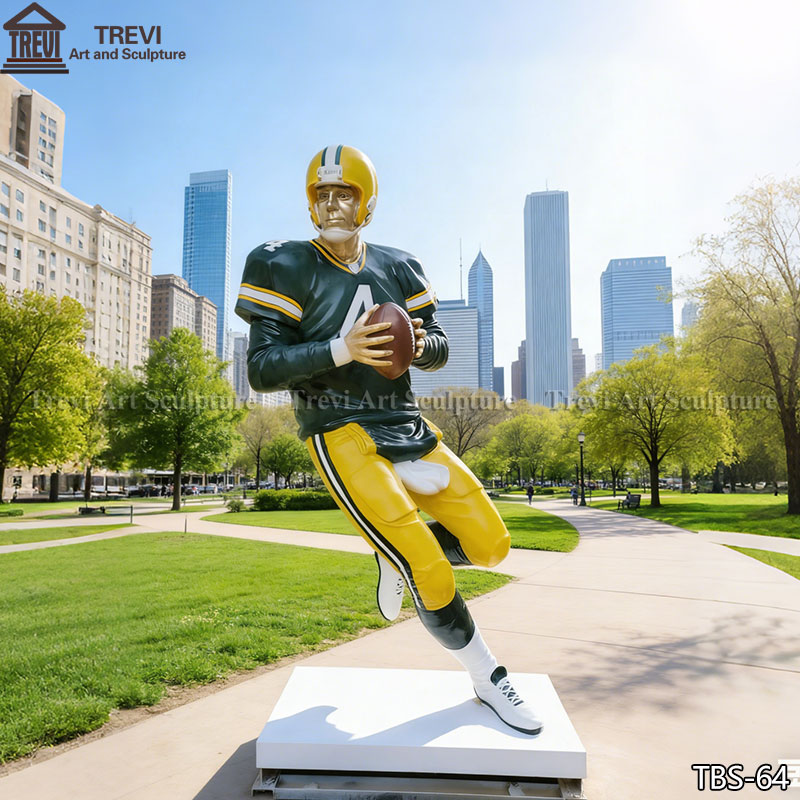 Image: Trevi’s American football player product page. Design reference; the pictured setting is not presented as a documented installation at your venue.
 Image: Trevi’s golfer product page. Use the pose and silhouette as references; confirm any named likeness or inscription rights for your own commission.
 Image: Trevi’s diver product page. A site photo or product image does not replace a foundation or safety assessment for a new venue.
3. Measure the site before choosing “life-size”
“Life-size” describes the figure, not the whole installation. A pedestal, a raised plinth, and projecting equipment can change both the visual scale and the engineering requirements. Send the sculptor the desired height, width, and depth of the figure, plus the base dimensions and any space reserved for a plaque. Note the surrounding doors, sightlines, canopy, landscaping, nearby services, and delivery access.
A simple site package should include:
- A dimensioned plan and photographs from the main viewing angles.
- The expected level of public contact, including whether fans will gather for photos or touch the base.
- The proposed foundation area and who will design and build it.
- Vehicle, crate, unloading, and lifting access, plus any restrictions during game days.
- The required arrival, installation, and unveiling dates as separate milestones.
Do not place a broad pose or projecting club into a circulation path just because it fits on a drawing. For U.S. projects, the U.S. Access Board’s guide to accessible routes explains why routes and clearances must be assessed as part of the site; elsewhere, use applicable local standards. A qualified local designer should review the actual layout, not a generic sculpture specification.
4. Write a brief that can support a meaningful quotation
A useful commission brief is more specific than “bronze athlete, life-size.” It states who or what is represented; pose and equipment; reference-image permissions; overall dimensions; number of figures; finish; inscription; pedestal responsibilities; site location; destination; approval contact; budget range; and unveiling date. If you want a replica-like interpretation of an existing design, say what may change and what must stay.
Request an itemized proposal rather than comparing headline figure prices. Ask whether concept work, clay-model revisions, bronze casting, patina, base or plaque, internal support, fixing details, crating, freight, customs, unloading, and installation assistance are included. A product-page price for an existing design is not a quote for a new portrait or a completed public-space installation.
At our factory, the general bronze commissioning process starts with a design brief and moves through modeling, casting, finishing, inspection, shipping, and installation guidance. For a sports venue, the important difference is that the venue’s decision-makers and site team must be aligned at every approval point.
5. Make the clay model your decisive approval stage
For a custom athlete, we create a clay model and send detailed views for review before bronze casting. This is where you can still resolve the face, anatomy, uniform folds, hands, equipment, and the rhythm of the pose together. Ask for front, back, profile, and three-quarter views, plus close-ups of any likeness, jersey details, and inscription. If the athlete or family is involved, include their review at this stage.
Nominate one person to consolidate comments from the venue, team, donors, and athlete’s representatives. A written approval should cover the overall pose, recognizable features, dimensions, and base concept. Changes after that point may require new modeling, tooling, and a revised schedule; avoiding the review to save a few days can create a much larger problem later.
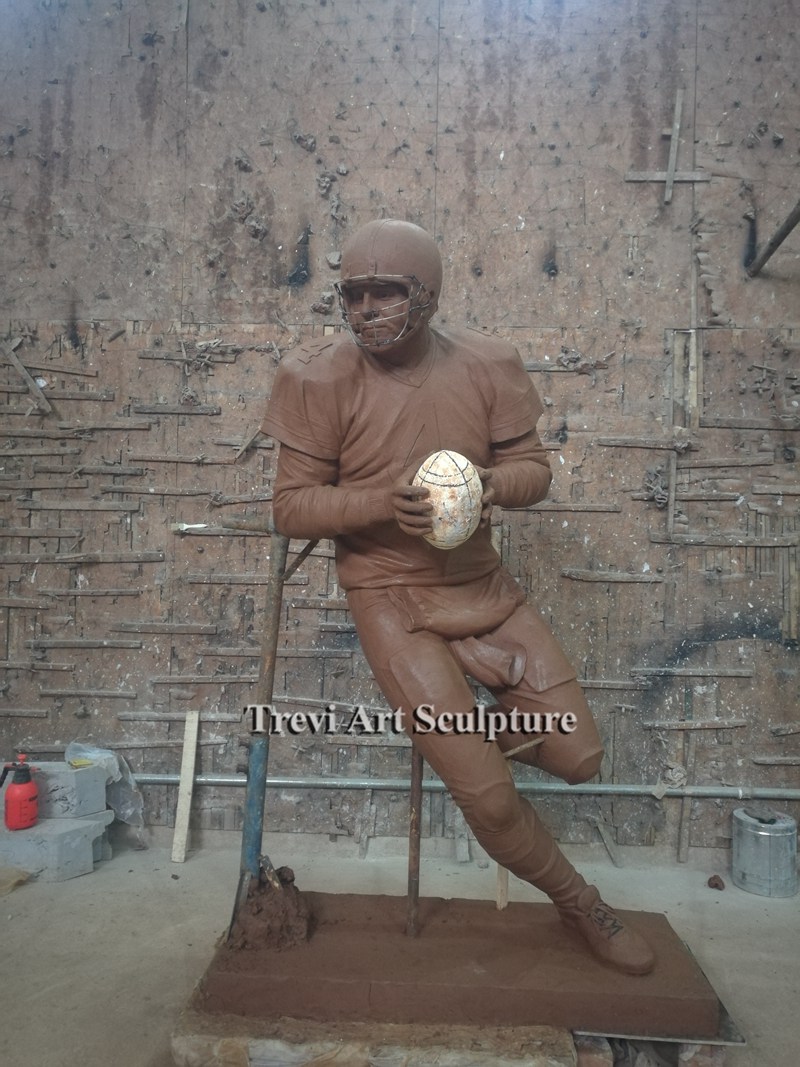 Image: Clay model shown on Trevi’s American football player product page. Review this stage from multiple angles before approving casting.
6. Confirm how the bronze will be cast and finished
After model approval, Trevi uses a lost-wax bronze casting process: mold making, a wax pattern, ceramic shell, casting, assembly, surface refinement, and patination. Large or complex poses can be cast in sections. The joints and the surface then need careful finishing; the Getty’s definition of chasing explains the detailed work used to correct or enhance the cast surface.
For a venue piece, approve a finish reference under realistic lighting. A dark patina may read differently in a shaded concourse and a sunny forecourt. Ask how an outdoor finish should be inspected and maintained in your climate, especially where visitors may touch the sculpture. Before shipment, review overall views and close-ups of the finished piece against the approved clay model and finish reference.
7. Plan the foundation, shipment, and unveiling backward
A finished casting is not an installed monument. Have the local structural engineer and installer review the sculpture’s final size, mass, center of gravity, base, anchorage, wind exposure, and ground conditions. The foundry can provide relevant dimensions and fixing information, but the project-specific foundation, permits, public safety, and site work must be verified locally. Do not specify anchor sizes or concrete details from a generic blog post.
Agree in writing who handles crating, insurance, freight terms, customs, on-site unloading, lifting, and the final fixing. The Canadian Conservation Institute’s shipment guide highlights the need to plan around an object’s dimensions, weight, vulnerable projections, handling route, and transport hazards.
Work backward from the ceremony: unveiling → installed and inspected → delivered and unpacked → dispatched → finish approved → clay model approved → complete brief received. Trevi’s custom bronze statue timeline guide gives about one month to 45 days of foundry production for a single life-size figure as a preliminary planning range. It is not a guarantee of installation by that date; a large monument, an original portrait, revisions, shipping, and site work can extend the total schedule.
8. Hand over a maintenance plan, not just the statue
At acceptance, document the approved finish, installation drawings, anchorage information, inspection photos, cleaning guidance, and contacts for future repairs. Assign a venue staff member to check the sculpture and base periodically for coating wear, loose fixings, staining, and damage from public contact. Ask the fabricator or a qualified conservator before applying cleaners or renewing a coating: treatment should suit the actual patina and local conditions.
A sports venue changes over time. Landscaping grows, crowd routes change, and photo-taking can concentrate wear at one edge of the base. Include the sculpture in the venue’s normal site-inspection program so that its artistic presence and public safety are managed together.
Questions venue teams ask before commissioning
How much does a custom athlete statue cost?
It depends on the original modeling, portrait detail, pose, dimensions, finish, base, freight, and installation scope. Ask for an itemized project quotation. An existing product’s listed price should not be treated as the total cost of a commissioned venue monument.
Can we commission a recognizable athlete from photographs?
Yes, photographs can guide the modeling, but you should provide multiple authorized views and confirm the rights needed for the likeness, images, uniform, and team marks before production. Name the person who will sign off on the face at the clay-model stage.
When should we involve an engineer?
As soon as the site and approximate pose are chosen. The engineer and installer need time to evaluate the base, structural support, ground conditions, wind exposure, access, and any applicable approvals before installation.
How long should we allow before an unveiling?
Allow for design and stakeholder approval, clay review, foundry production, transport, customs where relevant, and site installation. Trevi’s preliminary production range for a single life-size figure is about one month to 45 days at the foundry, not from first inquiry to unveiling. Request a milestone schedule for your specific project.
Can we adapt an existing sports statue design?
An existing design can be a useful starting point, but changes to the pose, portrait, uniform, equipment, scale, or base should be reviewed and quoted as part of your own commission. Explore the sports statue category to compare directions before selecting one.
What should we approve before the bronze is cast?
Approve the clay model from multiple angles, including the face, equipment, silhouette, uniform, overall scale, and any elements that affect the base or public clearance. Record one consolidated sign-off so later changes are identifiable.
Start with the site and the story
The best first step is not choosing a catalog image; it is sending a clear brief. Tell us whose achievement the venue wants to honor, where people will encounter the statue, the size of the available space, who can approve the design, and when it must be installed. Trevi can then discuss a custom pose, show relevant bronze sports sculpture options, and prepare a proposal that separates the sculpture from the site’s engineering and delivery responsibilities. Send your references and venue photos to info@trevistatue.com to begin the conversation.


