Few artists have turned a single motif into a global visual language the way Yayoi Kusama has done with the polka dot. Across six decades, her large-scale outdoor sculptures — installed everywhere from a quiet fishing pier in Japan to a sculpture park in Norway — have become some of the most photographed public artworks in the world.
At Trevi Statue, we spend our days thinking about how large sculptural works are actually built: the substrate, the paint system, the way a piece needs to be engineered to survive sun, salt air, or snow for decades. That perspective gives us a slightly different lens on Kusama’s work than a typical art-history overview — we’re as interested in how these pieces are made and maintained as in what they mean. Below, we walk through four of her best-known sculptures, what makes each one significant, and a few production details that most articles skip.
1. Yellow Pumpkin — Naoshima, Japan (1994, rebuilt 2022)
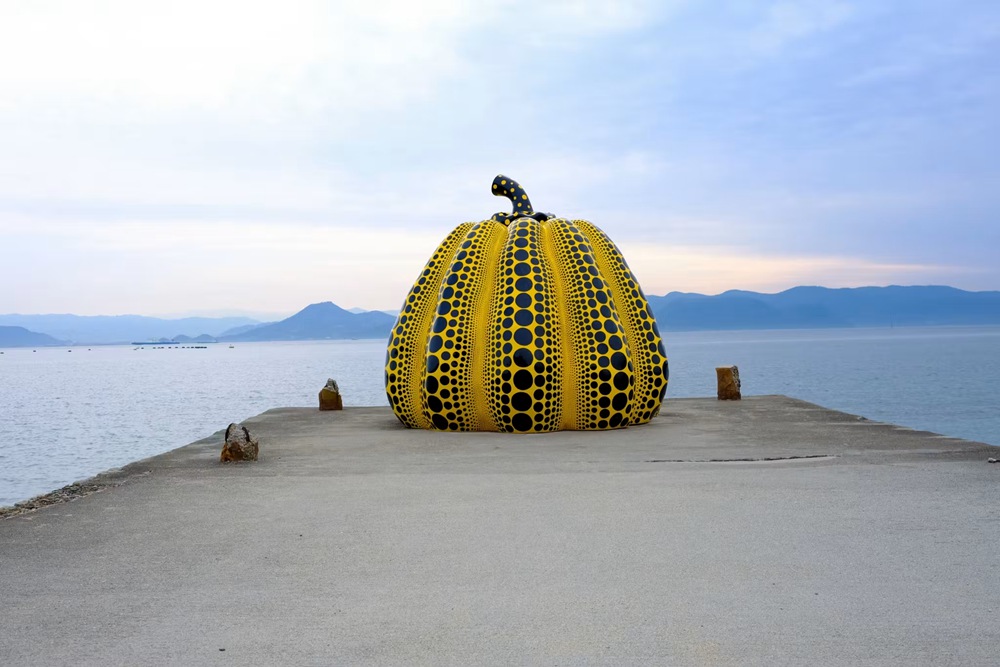
Kusama’s Yellow Pumpkin on Naoshima Island is arguably her most photographed work. Solid yellow with bold black polka dots, it sits at the end of a stone pier in the Seto Inland Sea, part of the Benesse Art Site Naoshima open-air collection.
A common misconception — repeated on many websites — is that this was Kusama’s “first sculpture.” It wasn’t. She had already produced pumpkin sculptures before 1994. What made the Naoshima piece a milestone was that it was her first sculpture designed specifically to live outdoors permanently, sited with the surrounding sea and sky in mind from the start.
That distinction matters for anyone thinking about commissioning outdoor art: an indoor sculpture and a permanent outdoor installation are engineered completely differently. The original Naoshima pumpkin was built from fiberglass-reinforced plastic (FRP) — a material choice that let it hold vivid, UV-stable color while staying light enough to sit safely at the end of a pier. In August 2021, a typhoon swept the sculpture into the sea, cracking it into three pieces. Kusama’s studio rebuilt it rather than simply patching it, using a shell roughly 10% thicker and adding an anchor point so it can be secured or removed quickly before future storms. The rebuilt pumpkin was reinstalled in October 2022 and remains one of the most visited artworks in Japan.
The lesson for outdoor sculpture in general — something we deal with constantly at Trevi Statue — is that material selection and structural reinforcement aren’t just technical footnotes; they determine whether a beloved piece survives its environment for one season or for thirty years.
2. Flowers That Bloom at Midnight (2009–ongoing series)
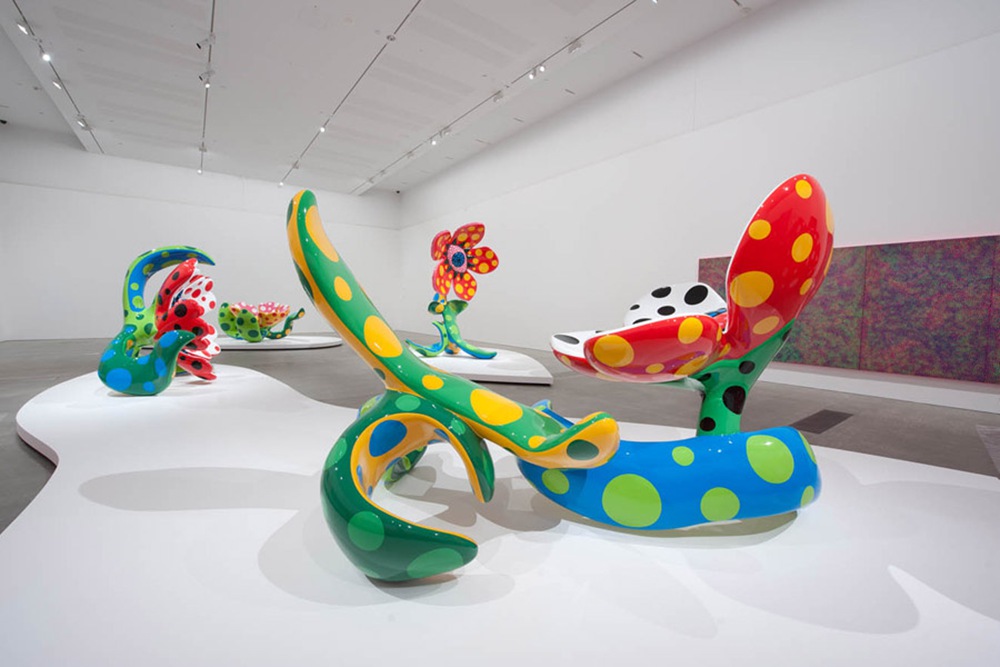
This is actually a series of roughly 18 large sculptures that Kusama began developing in 2009, each cast in fiberglass-reinforced plastic and finished by hand in urethane paint — a process chosen for its durability and color saturation on large, curved surfaces exposed to weather. Individual pieces from the series have appeared in very different settings, from the Gagosian Gallery in Los Angeles to the Jardins des Tuileries in Paris and residential plazas such as 33 Tehama in San Francisco.
Flowers have been part of Kusama’s visual vocabulary since childhood; she has spoken about them representing opposites at once — life and death, celebration and mourning, masculinity and femininity. The oversized eye at the center of each flower and the polka-dotted petals push the work somewhere between botanical and surreal, which is part of why the series reads so differently depending on where it’s installed — tucked into a garden versus standing alone in a plaza changes the piece’s whole character.
From a fabrication standpoint, this series is a good example of scalable public art: the same sculptural concept is reproduced at different sizes and color combinations for different sites, which is exactly the kind of customization Trevi Statue offers clients who want a signature large-scale piece without a one-off engineering process each time.
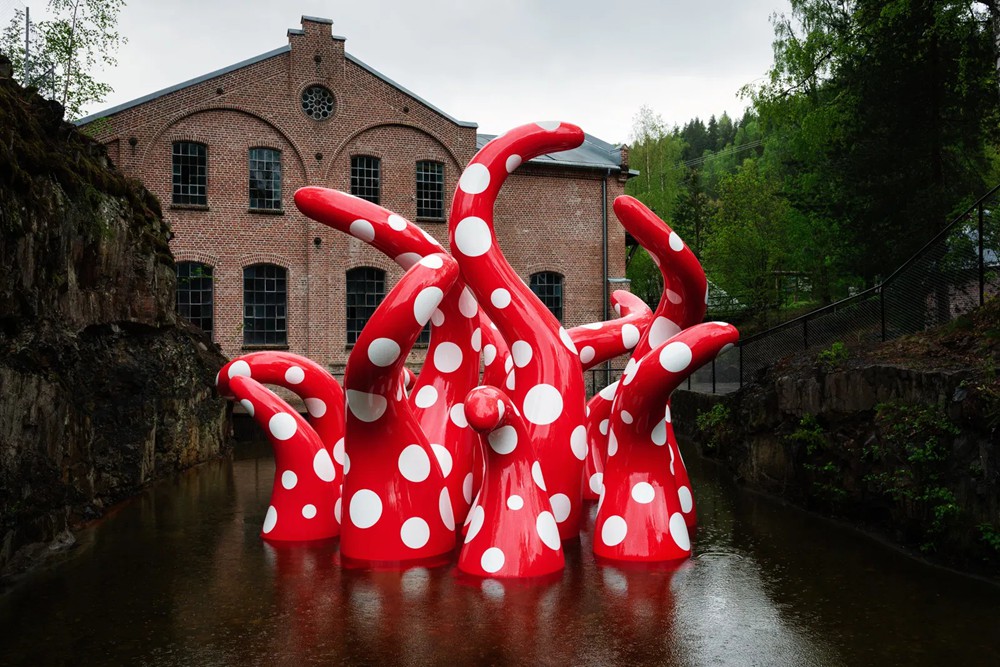
3. Shine of Life — Kistefos Museum, Norway (2019)
Shine of Life is Kusama’s largest sculpture in the Nordic countries. Cast in aluminum and painted in her signature red-and-white polka dots, the piece consists of tentacle-like forms that appear to rise directly out of a mill pond at the Kistefos sculpture park. Development of the site-specific work began in 2012 and was finally unveiled in 2019, underscoring how long large-scale public commissions can take from concept to installation.
Kusama described the work as an expression of hope, writing that her wish for a peaceful, connected world was carried into the piece. The choice of cast aluminum over fiberglass here is notable: near water, in a cold climate, a metal casting resists weathering differently than FRP does, which is one reason material choice should always follow site conditions rather than the other way around.
What these three works have in common
- Every one of them was engineered for a specific site and climate before a single dot was painted.
- Material choice — FRP, cast aluminum, hand-applied urethane paint — was driven by durability requirements, not just aesthetics.
- Scale is part of the message: Kusama’s sculptures work because they’re large enough to physically surround the viewer, not just be looked at.
Bringing Kusama-inspired large-scale sculpture to your own space
You don’t need a museum commission to bring this kind of bold, oversized sculptural presence to a garden, plaza, resort, or storefront. At Trevi Statue, we custom-fabricate large sculptures in the same range of materials used in works like these — fiberglass-reinforced plastic, cast bronze, stainless steel, and resin — engineered for your specific site, climate, and budget. Whether you’re after a polka-dot pumpkin for a public art installation, a bronze figurative piece, or a fully custom design, our team can advise on the right material and finish before we start fabrication.
If you’re planning a public art or landscape sculpture project, get in touch with our team for a material and feasibility consultation.