
Who was Medusa, and why do her sculptures look so different? In Greek myth, she is the mortal Gorgon whose gaze could turn a viewer to stone. In art, however, she has never had just one face. Ancient artists used her head as a protective emblem; later sculptors made her part of heroic scenes, gave her an unsettlingly human expression, or reversed the story altogether. Looking at five famous works reveals not only the history of sculpture but also how each age chooses to see Medusa.
Who was Medusa in Greek mythology?
According to Hesiod’s Theogony, Medusa was one of three Gorgon sisters—and the only mortal one. Perseus, aided by divine gifts, approached her without looking directly at her face, severed her head, and escaped with it. In the myth, the head retained its power even after her death. The Metropolitan Museum of Art’s account of Medusa in ancient Greek art explains why images of her appeared not only in scenes of Perseus’s adventure but also on buildings, vessels, jewelry, and shields.
There is an important distinction between early Greek traditions and later retellings. The often-repeated story of a once-beautiful Medusa transformed after an encounter with Poseidon is associated with the Roman poet Ovid; it should not be presented as the one original version of the Greek myth. Those different narratives help explain why one sculpture can emphasize danger, another sorrow, and another resistance.
Why did ancient people place Medusa’s face on objects?
A frontal Gorgon face—called a gorgoneion—could serve an apotropaic purpose: an alarming image intended to ward off harm. That is the apparent paradox of Medusa in ancient art. The face that threatened to petrify also became a protective sign. The Met notes that early examples might show staring eyes, bared teeth, and a protruding tongue, while later representations became more human and composed. The snake hair familiar today was not equally prominent in every period.
This visual transformation matters when looking at sculpture. Ask whether the work shows Medusa herself, only her head, or Perseus displaying her head. All three depict the same myth, but they place the viewer in very different positions.
Five famous Medusa sculptures, from antiquity to the present
1. Medusa Rondanini — an ancient head with a human face
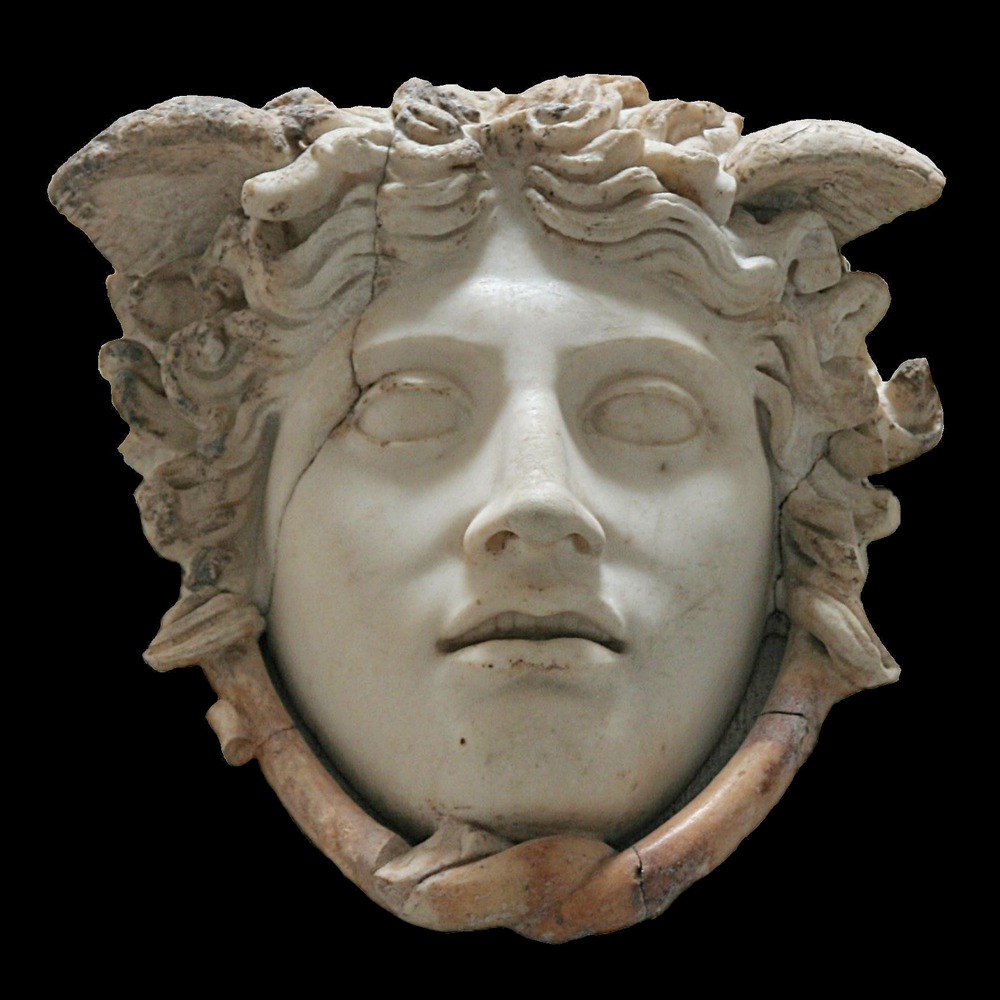
The Medusa Rondanini is a marble head in Munich’s Glyptothek. The museum identifies it as a Roman-period copy of the Medusa head on the shield of the Athena statue in the Parthenon, whose model dates to about 440 BCE. That is more precise than calling this marble head a surviving original by the Greek sculptor Phidias: the object we see is a later copy, and the ancient model belongs to an earlier context.
Rather than lunging at the viewer with a grotesque grimace, this Medusa has a relatively calm, idealized face. Small wings and serpentine elements keep her identity legible, yet her humanity comes forward. She is a useful reminder that ancient artists could make the Gorgon beautiful without erasing the myth’s disturbing power.
2. Benvenuto Cellini, Perseus with the Head of Medusa — victory in bronze
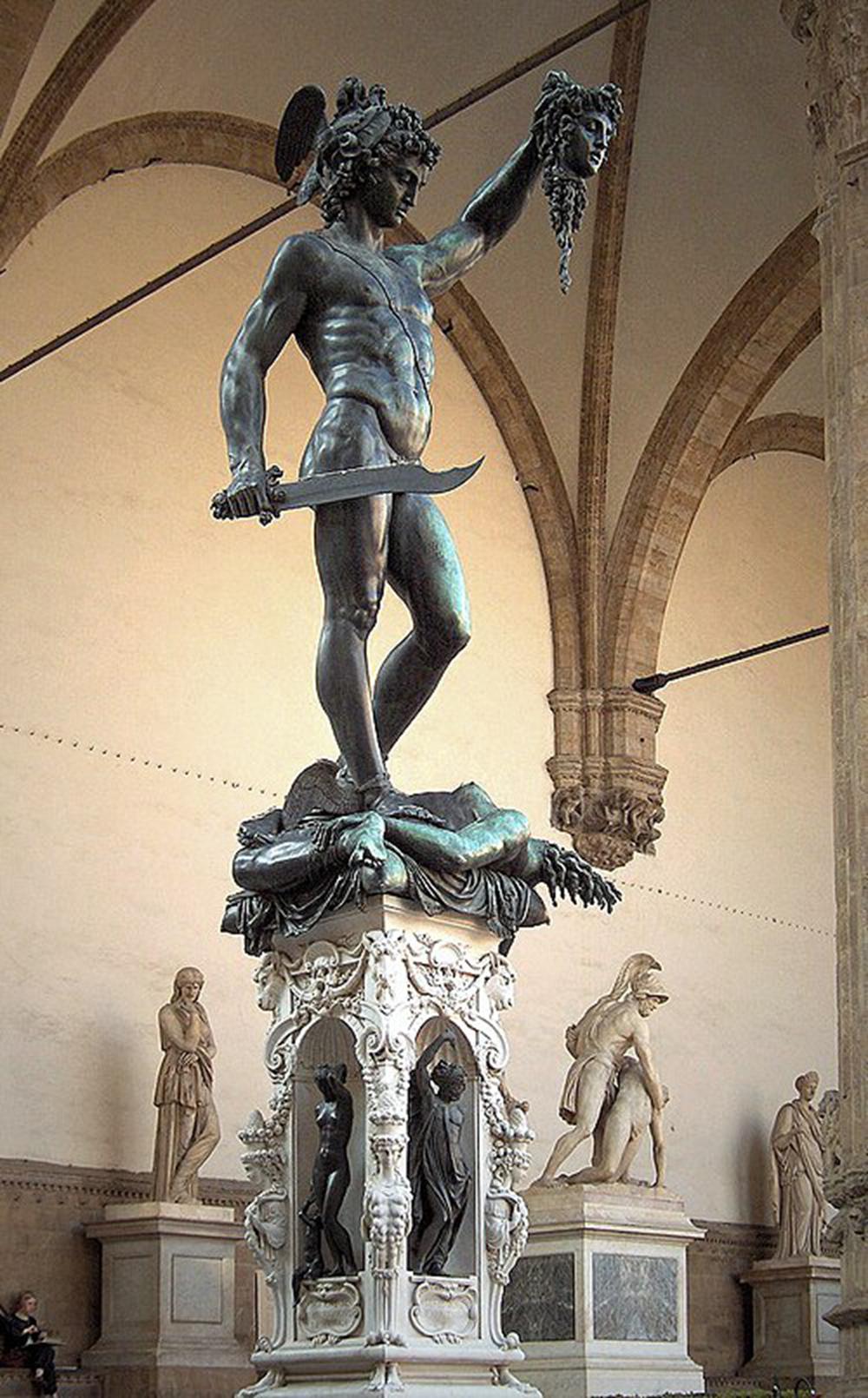
Under the Loggia dei Lanzi in Florence, Cellini’s monumental bronze shows Perseus holding up Medusa’s severed head above her body. Completed in the mid-16th century, the sculpture turns the myth into a forceful public spectacle: an upright hero, a raised trophy, and a composition designed to be seen in a civic square.
The Uffizi Galleries describe the sculpture’s prominent position under the Loggia and explain its political significance for Cosimo I de’ Medici. Cellini is not giving us a portrait bust of Medusa; he stages a victory for people approaching the square to see. That distinction makes the work a revealing point of comparison with Luciano Garbati’s later reversal.
3. Gian Lorenzo Bernini, Bust of Medusa — fear seen from the inside
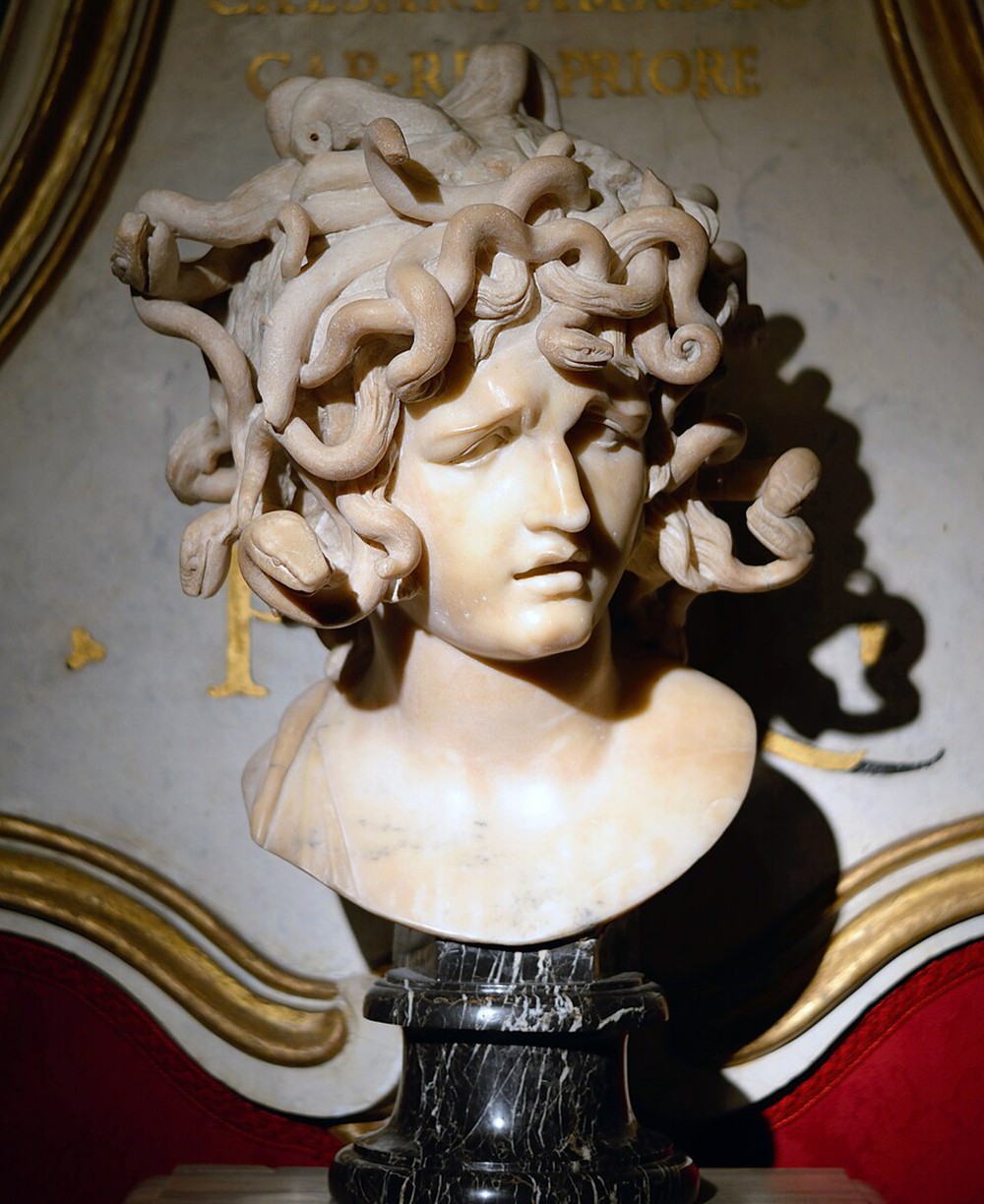
Bernini removes Perseus from the scene entirely. His marble Bust of Medusa, dated 1644–1648 by the Capitoline Museums, shows a living figure reacting with anguish, her face surrounded by snakes. It is a bust, not a severed trophy head—a difference the museum itself emphasizes.
The museum reads the work as a Baroque meditation on transformation: Medusa imagines seeing herself and turning into stone. Because the sculpture itself is marble, Bernini can make the mythical curse into a reflection on what a sculptor does. Viewers encounter her expression before they decide whether to see her as frightening, frightened, or both.
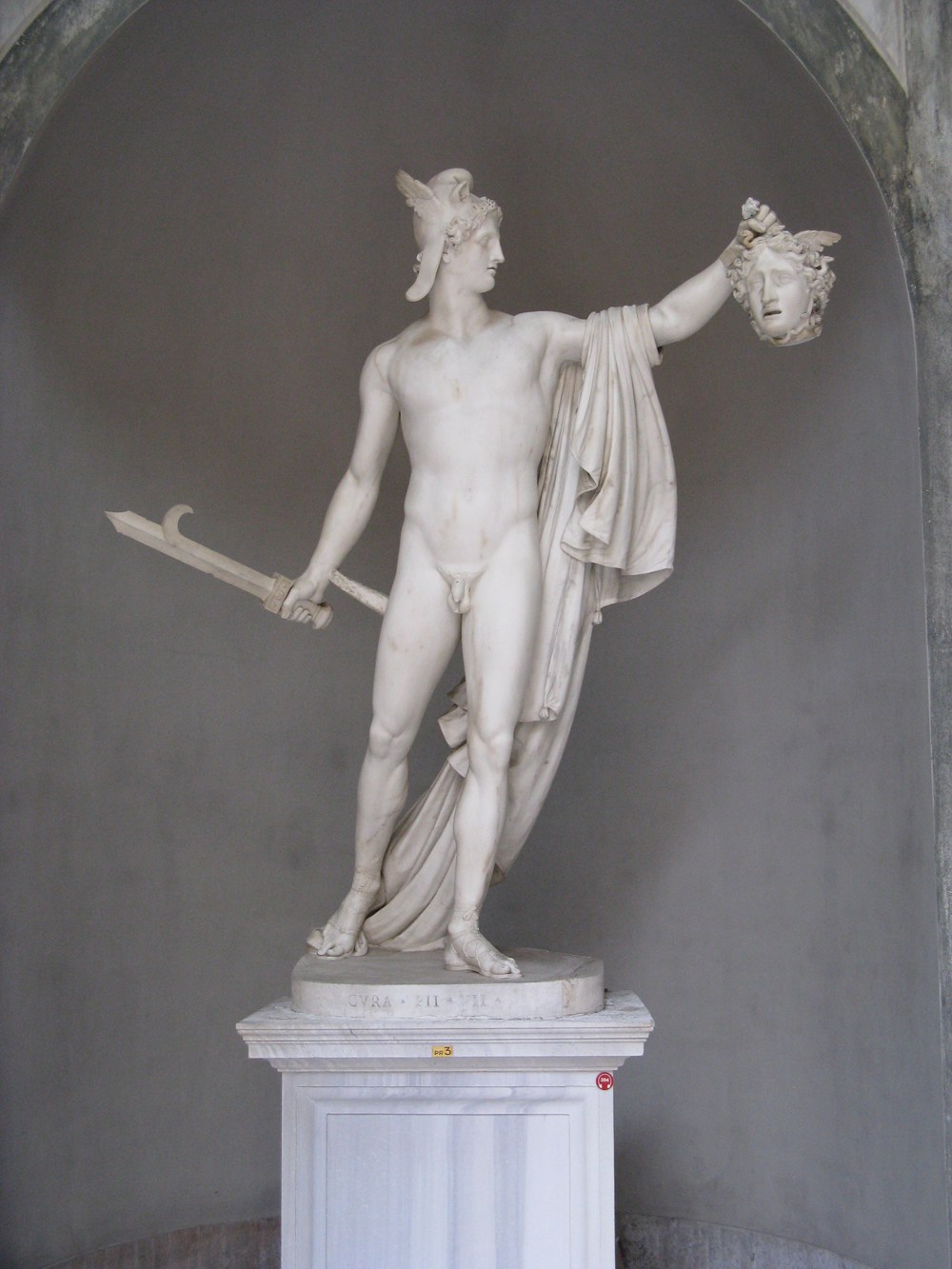
4. Antonio Canova, Perseus with the Head of Medusa — an idealized hero in marble
Canova also shows Perseus holding Medusa’s head, but the mood is markedly different. In the Vatican Museums’ Perseus Triumphant, carved between late 1800 and early 1801, the hero’s measured pose and elegant proportions take precedence over the violence of the act. The museum specifically notes the influence of the Apollo Belvedere on the statue’s proportions and expression.
This is a Neoclassical treatment of the subject: controlled, idealized, and focused on the heroic figure. Versions of the Perseus composition are associated with different dates and collections, so dates and museum locations should be attached to a specific version, not applied to every sculpture with this title. Trevi’s marble Perseus-and-Medusa product page presents a hand-carved, Canova-inspired option; it is a modern offering, not Canova’s museum original.
5. Luciano Garbati, Medusa With The Head of Perseus — a reversal of the myth
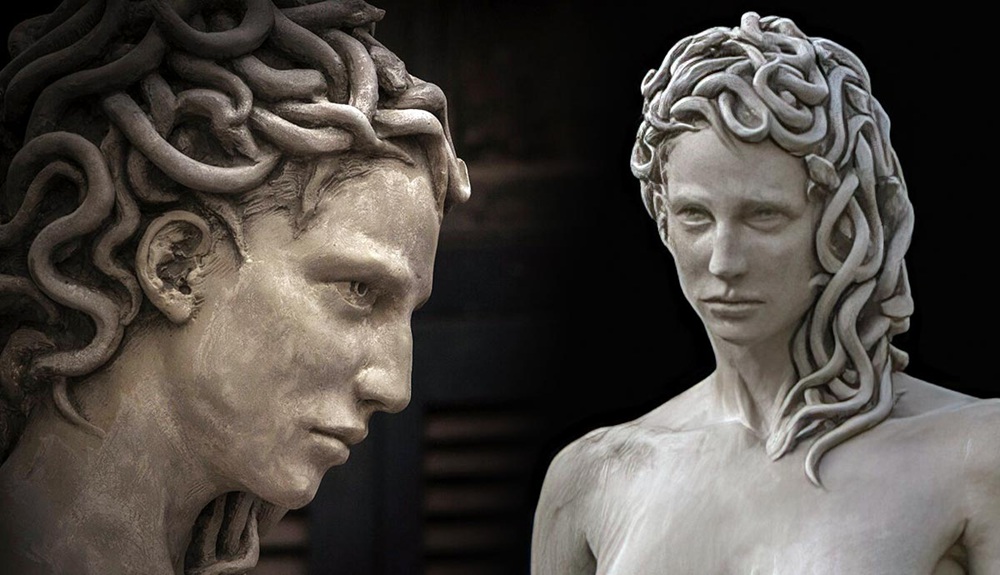
Garbati switches the figures’ roles: Medusa stands holding Perseus’s head. The work was created in 2008, and a bronze version was temporarily displayed in Manhattan’s Collect Pond Park from October 2020 to August 2021. It is not a permanent installation there; NYC Parks lists it as a past exhibition.
The placement of the head deliberately recalls Cellini’s Perseus, while asking whose perspective a heroic victory leaves out. NYC Parks interprets Garbati’s figure in terms of self-defense and a later account of Medusa as a victim. The modern reading has prompted conversation about gender and justice, but it should not be projected backward as the sole meaning of all ancient Gorgon images. This is also a contemporary artist’s work, not a public-domain antique to copy freely.
What changes when the material, pose, or setting changes?
A marble head such as the Medusa Rondanini concentrates attention on the gaze. Bernini’s marble bust adds psychology through expression and turning snakes. Cellini’s bronze group uses height, silhouette, and an outdoor civic setting to make triumph visible from a distance. Canova’s polished marble favors composure. Garbati’s bronze retains the standing-and-raised-head format but changes who holds power.
The pose also changes the question a viewer asks. A frontal Gorgon seems to ask, “Will you meet my gaze?” A victorious Perseus asks us to look at the hero. A Medusa shown alone—or one who has taken control of the narrative—asks us to consider her as a subject. That is why a single keyword, “Medusa statue,” can lead to very different works of art.
How can you choose a Medusa-inspired sculpture for your space?
Start with the interpretation you actually want, not just the myth’s name. A Medusa head or bust makes an intimate focal point for an interior, while a full figure of Perseus and Medusa needs room for the raised arm, the base, and viewing from several angles. Check the piece’s material, overall dimensions, pedestal, finish, placement, and whether you want a faithful classical reference or a clearly original reinterpretation.
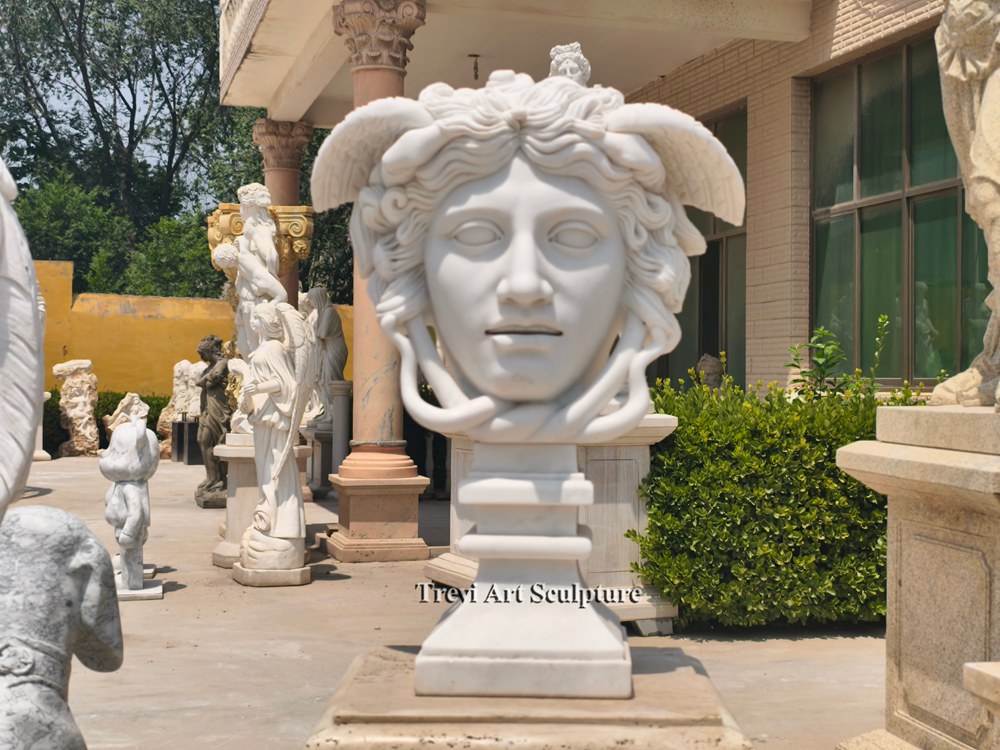
For buyers drawn to the historical Perseus composition, Trevi lists a bronze Perseus with the head of Medusa sculpture and a hand-carved marble Perseus inspired by Canova. These are Trevi’s products, not the original artworks in Florence or the Vatican. Compare the product images and discuss the final size, details, and finish before ordering; a catalog image alone is not a project specification. For a broader look at classical subjects, see our guide to Greek mythology sculptures.
 Trevi product-page photograph of its bronze Perseus and Medusa design; not a photograph of Cellini’s original in Florence.
If you have a reference image in mind, distinguish an ancient mythological subject from the design and rights in a particular modern artwork. Discuss permissions before requesting an exact copy of a living artist’s sculpture. For a custom commission, ask to review the model before production and get a written proposal covering the sculpture, base, delivery, and installation responsibilities. Trevi outlines that sequence in its custom bronze sculpture commissioning guide.
Frequently asked questions about Medusa sculpture
Was Medusa always shown with snakes for hair?
No. Ancient depictions changed over time; the Met notes that the familiar snake-haired image did not appear consistently across every early representation. Staring eyes and a frontal face were often just as important in identifying the Gorgon.
Why was Medusa’s head considered protective?
The gorgoneion functioned as an apotropaic image: its frightening appearance was meant to repel threatening forces. That is why it could appear on architectural decoration, armor, and jewelry rather than only in narrative sculptures.
Is the Medusa Rondanini an original Greek sculpture?
The Munich Glyptothek describes it as a Roman-period marble copy after an earlier Greek image of Medusa. Treating it as an original Greek carving—or securely naming its individual sculptor—would overstate what the museum says.
Are Cellini’s and Canova’s Perseus statues the same work?
No. Cellini’s is a Renaissance bronze in Florence’s Loggia dei Lanzi; Canova’s Vatican Perseus Triumphant is a Neoclassical marble carved around 1800–1801. They share a mythological subject but differ in material, date, setting, and artistic purpose.
Is Bernini’s Medusa a severed head?
No. The Capitoline Museums catalog it as a bust showing Medusa as an expressive figure in the process of transformation, not simply as a trophy held by Perseus.
Can I buy or commission a Medusa-inspired statue?
Yes. Choose the depiction and material that suit your space, then compare a proposed piece with the actual product listing or approved custom design. Trevi’s bronze and marble Perseus-and-Medusa pages are practical starting points. If your reference is a contemporary artist’s specific design, clear the necessary reproduction rights first.
Bring the story into your space
If the drama of Cellini’s bronze appeals to you, explore Trevi’s bronze Perseus and Medusa design. If you prefer Canova’s calmer classical silhouette, view the natural-marble Perseus option. Tell Trevi where the sculpture will stand, the size you need, and which details matter most; then request a project-specific quotation through the product page or at info@trevistatue.com. The myth offers the inspiration—your space determines the right sculpture.


