
A custom life-size bronze statue typically takes 30 to 45 days to make in our foundry. That is my initial planning range for a single life-size figure, not a promise that it will be installed in 45 days. From my experience in bronze sculpture production at Trevi, the exact foundry schedule depends on the design, modeling, approvals, casting, and finishing. Shipping, customs, and on-site installation need additional time.
A small tabletop piece and a large monument do not follow the same schedule. Nor does a new portrait with several approval rounds move like a design based on an available model. I use the ranges below to start the conversation, then build a project-specific schedule once I know your subject, dimensions, references, finish, destination, and required date.
How long does production take for different statue sizes?
These are Trevi’s preliminary production planning ranges, not a record of every completed order or a guaranteed quotation. They refer to making and finishing the sculpture at the factory, assuming the project requirements are agreed and approvals arrive without extended delays. Design changes, long client review cycles, shipping, customs, foundation work, and installation can extend the overall project. A compact but intricate portrait or a complex life-size group may take longer than its size alone suggests.
You may also see a “Leading Time: 10–45 days” label on some Trevi project pages. I do not apply that broad page label automatically to every commission: a newly designed multi-figure monument should be assessed against the large-scale range and its actual scope. The page label does not separately specify design decisions, client approvals, international transport, customs, or site work.
First, which clock are we measuring?
When I prepare a schedule, I put four dates on it. Without them, a single “completion date” can be misleading.
Some tasks can happen in parallel. A local contractor might prepare a pedestal while we finish the bronze, for example. Others cannot: I will not schedule mold making on a portrait while its clay likeness is still awaiting approval. That sequence—rather than the date of the metal pour—often sets the earliest realistic finish.
Where does the time go inside a bronze foundry?
Our complete commissioning guide covers the full process from idea to installation. Here I focus on the points where time is used, saved, or lost.
1. Brief, quotation, and design direction
I begin with the subject, reference photos or drawings, height, width and depth, pose, number of figures, intended site, preferred patina, base, budget, and deadline. A front-view photo and a requested height alone are rarely enough to plan a projecting arm, broad wings, or a complex group. These choices affect the model, how many sections we might cast, how the crate will be built, and whether the receiving site has room to handle it.
This stage ends when we agree what is actually included in the commission. If a committee is still deciding between a standing portrait and a three-person memorial, I would not count those discussions as a fixed number of foundry days. I would first help them settle the design direction and then issue a schedule tied to it.
2. Clay modeling and approval
For an original figure, our sculptors develop the form in clay. This is where we solve likeness, expression, anatomy, clothing, gestures, and the relationship among figures. In our Romanian reunion memorial, the emotional center is the space and hand contact between a returning soldier and his father; the clay stage was where those details could be judged together. The project page documents the design and fabrication, but does not publish a stage-by-stage duration.
I send views of the model for review before casting. If your project is a portrait, I ask you to check the face from more than one angle; if it is a group, check the spacing, sightlines, and how the figures relate to the planned site. Consolidated comments from one decision-maker are easier to act on than separate, conflicting replies from several stakeholders.
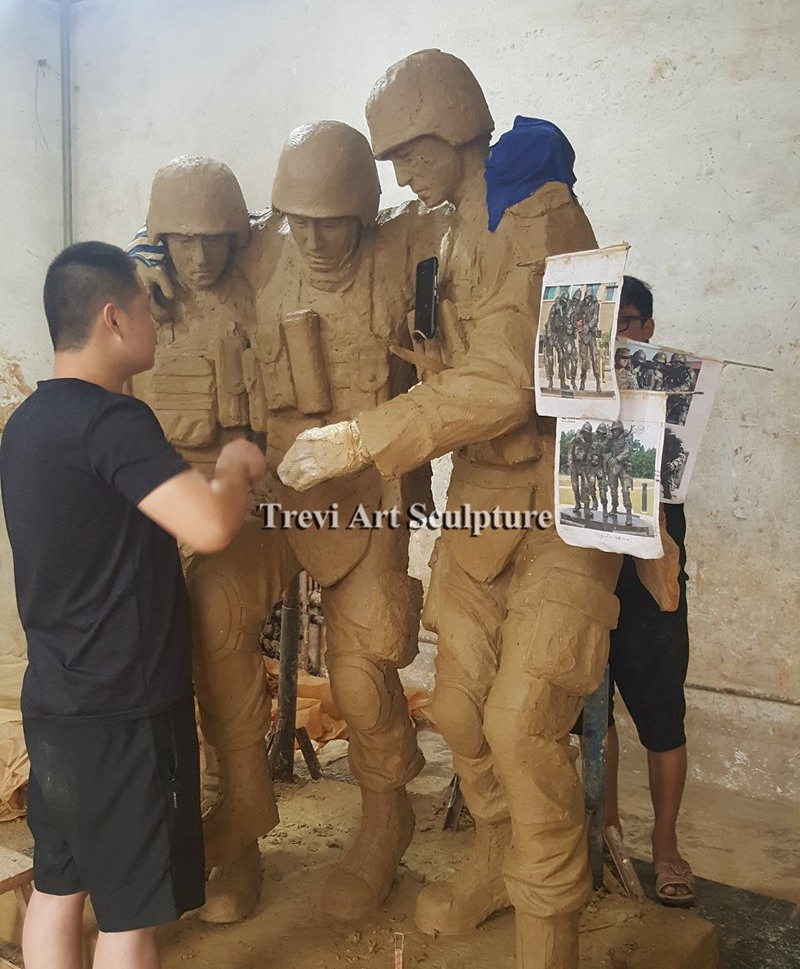
The model-review stage is a schedule checkpoint, not a step I would skip to rush the casting. See the documented museum memorial project.
3. Mold making, wax, ceramic shell, and bronze casting
After the model is approved, we move through silicone mold making, wax pattern preparation, ceramic shell building, dewaxing, and bronze casting. Our lost-wax process page illustrates these operations in detail. The stages are linked: a wax needs to be checked before it is invested, and a shell needs appropriate preparation before metal is poured. Removing necessary preparation or inspection to make a promised date look shorter is not a sound production plan.
Large figures may need to be divided into castable sections. That adds mold and wax work, multiple castings, and later assembly. An existing suitable model or mold may shorten original sculpting, but I would first check whether it actually matches the requested size, pose, surface details, and condition. A significant change can erase much of the apparent time saving.
4. Welding, chasing, patina, and inspection
A raw casting is not a finished statue. We may need to join sections, refine connections, restore details along seams, prepare the surface, and apply the agreed color and protective finish. The Getty’s technical definition of chasing describes the fine work used to correct or enhance a cast surface. This is one reason I would not equate “the bronze has been poured” with “the statue is ready to ship.”
A dark, even patina and a finish with contrasting highlights also require different review decisions. I ask for a clear finish reference before this stage, then check the sculpture as a whole and in close-up. The time required to correct an unsatisfactory joint or surface matters more than a neat but unrealistic date on a quotation.
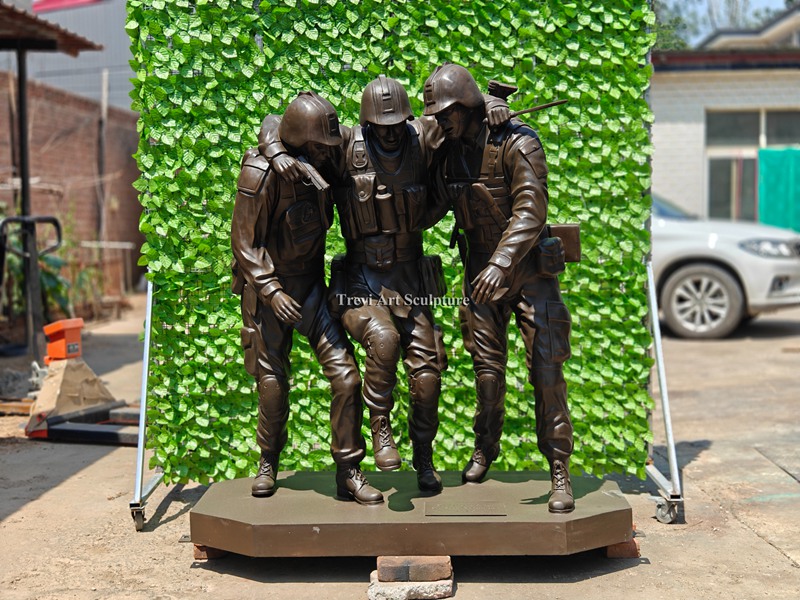
Compare the finished group with its clay stage in the Trevi museum project; the site photographs on that page were shared after installation and do not by themselves establish a production lead time.
Why can two custom statues have very different timelines?
When I estimate a project, I look beyond its height. These differences often have a greater effect:
Our bronze wildlife project shows why “large” is not the only useful descriptor: an eagle with extended wings and an elk with projecting antlers call for different structural, finishing, and packing decisions than a compact standing figure. That project page documents four animal pieces and their delivery, but it does not publish a verified day-by-day production record. I use it to explain the work, not to manufacture a standard lead time.
How I would plan a deadline backward
If you have an unveiling date, start with the installed statue—not the workshop dispatch date. I work backward through these questions:
- When must the local installer have access? Confirm foundation readiness, pedestal drawings, anchors, equipment, and site permissions with the responsible local professionals.
- When must the crate arrive? Confirm the destination, chosen shipping method, customs responsibilities, unloading access, and a sensible allowance for route-specific uncertainty.
- When must I finish inspection and packing? Agree on the finished-bronze photo or video review, corrections, crating, and shipping-document handover.
- When must you approve the clay model? Put a date and named approver on the most important artistic checkpoint. If the model changes substantially afterward, reassess the later milestones rather than pretending the original calendar is unchanged.
- What is the latest date for a complete brief? Gather reference images, all dimensions, site plans, finish preferences, and any required inscription before modeling begins.
For an international project, I keep foundry production, shipping, customs, and installation as separate lines. Trevi’s commissioning guide describes our packaging, progress review, and installation guidance; those are part of project planning, but they should not be silently compressed into a “casting time” estimate. A local installer or engineer should validate the foundation and fixing for the actual site. The Canadian Conservation Institute’s shipment guidance is another useful reminder that packing and transport require their own preparation.
Can we make it faster without sacrificing the result?
Sometimes. I can assess whether a suitable existing model can be used, whether a finish has already been agreed, and whether the base can be prepared while we work. A complete brief and prompt, consolidated feedback can remove avoidable waiting. Photos of the intended site let us identify handling problems before a large sculpture is cast.
But I will not claim that every stage can simply be overlapped. A portrait cannot be cast responsibly before the family signs off on the likeness; a large installation cannot proceed just because the bronze has arrived if its foundation or lifting plan is not ready. Speed up decisions and parallel site preparation—not the checks that protect the work.
Questions clients ask me about lead time
How long does a single life-size custom bronze statue take to make? My preliminary foundry-production range is about one month to 45 days. Once I review the design and approval requirements, I can estimate that particular order; delivery and installation are separate.
Does “10–45 days” mean my custom statue will be installed within that period? No. That number appears as a lead-time label on some project pages and does not define a concept-to-installation commitment. Ask me to specify separate dates for production completion, dispatch, delivery, and installation.
Is a small bronze bust always quicker than a life-size statue? Not always. A tabletop piece is commonly planned at about a month in our foundry, but a new portrait likeness can demand substantial modeling and review. I estimate the actual design, not its size label alone.
Will an existing mold save time? It may reduce original modeling if its condition, dimensions, and details suit the order. If you change the pose, face, or scale, we may need additional modeling or new mold work.
When should I send corrections? During the model review, before mold making. Later revisions can affect work already completed and require a revised schedule.
Is the delivery date the same as the unveiling date? No. Delivery must be followed by inspection, unloading, and installation; site approvals or landscaping may also have their own schedule.
What should I send for an accurate quote and timeline? The subject and reference images, intended size in three dimensions, number of figures, site and destination, preferred finish and base, decision-maker, and the date by which the statue must be installed.
Ask for a milestone schedule, not just a number
For a single life-size figure, I would begin with about one month to 45 days of foundry production; for a tabletop piece, about a month; and for a large-scale statue or monument, about two to six months. Those are starting ranges, not substitutes for a design-specific schedule. Tell me what you want to create, where it will go, and whether your deadline means workshop completion, delivery, or installation. I can then define the approval points and separate foundry work from transport and site preparation. For the broader sequence of commissioning a piece with us, read our complete guide to commissioning a custom bronze sculpture, or explore the Trevi custom bronze sculpture collection for possible starting forms.


